
Writing Process: The Outline
Since I'm in the process of outlining the second book of a planned trilogy, this month I'm going to discuss my outlining process. It's evolved a great deal, going from 'essentially nothing' when I started writing to 'complicated step-by-step plan' a few years ago to where I'm currently at.

Since I'm in the process of outlining the second book of a planned trilogy, this month I'm going to discuss my outlining and planning process. It's evolved a great deal, going from 'essentially nothing' when I started writing to 'complicated step-by-step plan' a few years ago to where I'm currently at.
The Idea
Sometimes I spend a while nailing down the exact idea, although in this case, not very long; I already knew more or less what's going to happen, being the middle book, and having just finished a set of revisions on the previous book. But I do a fair amount of sketching ideas, writing down characters or scenes I want to incorporate, and things like that in a notebook beforehand when I'm starting from nothing.
Summary
Once I have enough of a framework to know more or less what I'm doing (main characters, general notion, that kind of thing), I open up my plot document and get started with a one-sentence summary. I started doing that when I was learning how to actually plot things out and following a specific method, but it's still helpful to me, because if I can't sum it up quickly I probably need to think a bit more about what the central idea of the story is.
After I've got the one-sentence summary nailed down, I expand it into roughly a paragraph. I don't always stick to this pattern, either; sometimes I've gone straight to the paragraph.
For example, Corner the Maze's one-sentence summary: "A racecar driver is stranded in another dimension and must battle his way back home."
And its expanded paragraph: "Corner the Maze is an urban fantasy comic following Chimalli Ramírez, a racing driver who has found himself stranded in another dimension after veering off track during a sudden rain storm. He's still not sure whether he hit the wall or actually went through the strange glowing green portal, but either way, he's determined to fight his way back home and finish the race."
Whereas Verdant Shadows' expanded paragraph is: "Rowan Monaghan knows they must hide their non-human heritage and stay within the walls of Seeta. But when their mother vanishes into the shadow-wood during her research, they choose seeking her over safety, finding out who their true friends are and setting them on a collision course with the darkest of family secrets."
Seven Point Structure
I started adding this in because it's a quick way to make sure that I'm moving through a story structure while I'm expanding my idea. I sketch out in one sentence Hook, Plot turn 1, Pinch point 1, Midpoint, Pinch point 2, Plot turn 2, and Resolution, starting with the Hook, Midpoint, and Resolution and then working to fill in the other points. I don't stick to this 100%, but I'll end up with where I want the middle to be and what needs to happen in the end, and then fill in a few things that get the characters from the starting point to the middle and end.
Synopsis
After that, I'm on to the synopsis. This isn't the same synopsis that I'll use later for queries and such, which gets significantly more polished; this is to provide a framework for the next step, where I really start getting into the main plotting. I basically expand each of the seven points from the last step into at least one paragraph each and work in anything else I want to make sure to hit along the way (such as character moments, unresolved threads from the last book, and so forth).
Scene-by-Scene Outline
Then comes the step that I'm on right now, where I reference the synopsis to work out a scene-by-scene breakdown. I started doing this for comic scripts, but I do more or less the same thing for novels, just a little tweaked and with a different next step (for comics I go straight from this step into writing the script).
I try to keep my chapters relatively short, so each scene equates to a chapter here. I fill out Action, Goal, Conflict, Disaster, Reaction, and Dilemma, which is a format I picked up from my various 'how to plot' explorations years ago, but like with the seven point structure I don't 100% stick to that. Not every chapter really has all of those, but every chapter does have things going on that can be kind of fit into that.
Once I have a full list of chapters, I check to make sure I'm hitting everything that I need to hit, and then go on to the next (and final) planning step...
Chapter Scripts
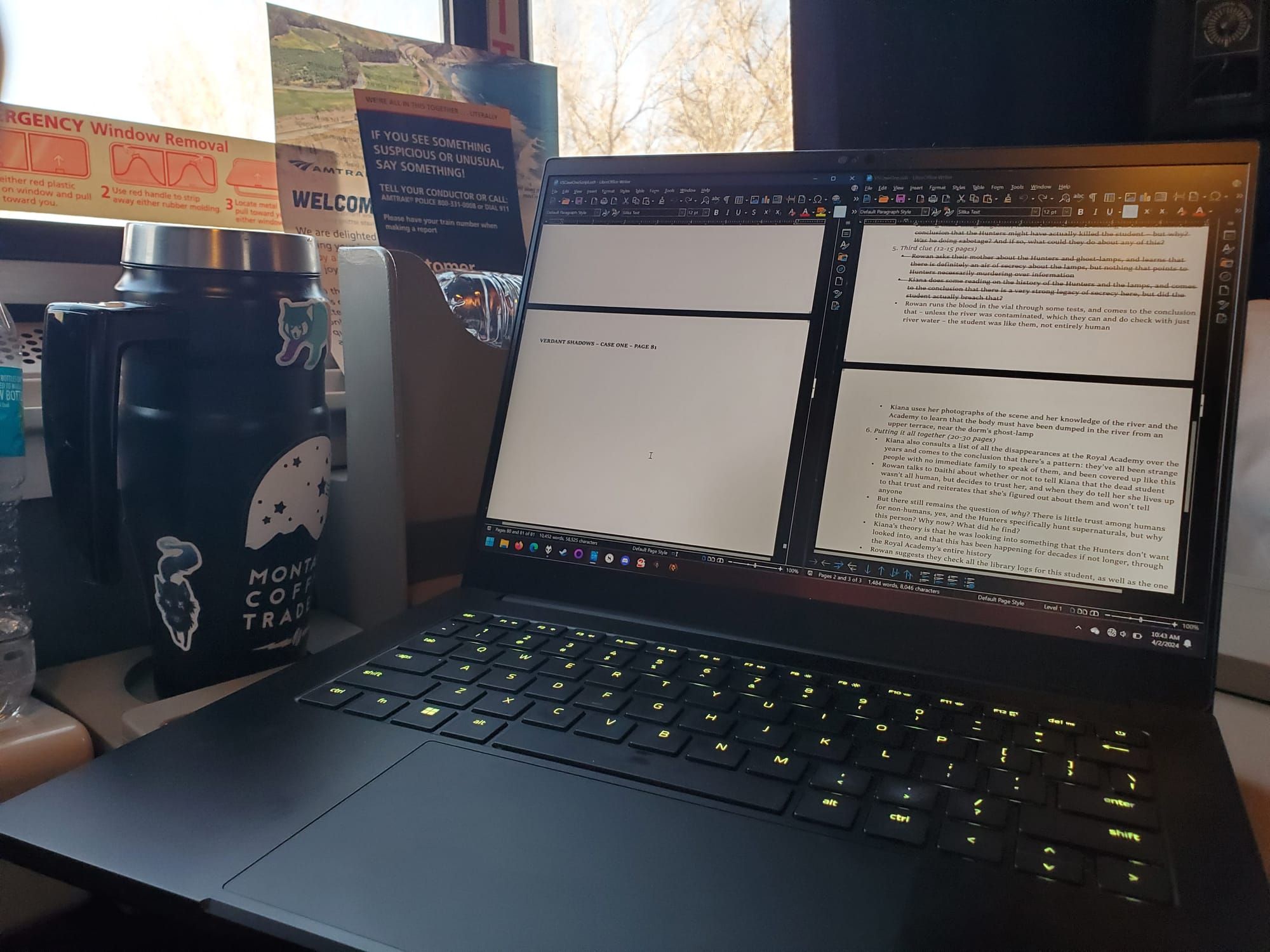
This is something I've only recently started doing for novels, originally as an experiment, but I've found that it does help and reduces that rather large number of drafts that I tended to go through. I take my scene-by-scene outline and have it open in one window while I write out a one-page chapter script in the other. Here I'm trying to actually think about what I'll be writing in a little more detail, so it generally takes longer, and this is the only stage where I'll actually jump around a bit if I'm more sure of a chapter that has to happen later. The finished chapter scripts document is what I'll then go off when I'm finally writing the first draft, and sometimes I refer back to it for future drafts as well, if I'm making major changes.
Deviations
When I went looking back through my old plotting documents to maybe take some screenshots to include in this post, I realized that I deviate from this process signficantly on almost every project. I use at least most of it, and running through the basics does help, but sometimes I just have a whole bunch of bullet points for scenes and sometimes I go through the entire thing in detail. (Like this time.)
Often I switch it up if I'm getting stuck, because looking at the problem from a different angle tends to help in that case.